Asbestos is one of the most misunderstood subjects in older homes. Some people assume it was banned decades ago and is no longer a concern. Others assume that any amount of it makes a house unsafe. Neither is accurate. This guide covers what asbestos is, where it turns up in houses, what health agencies say about the risk, what a Texas home inspection does and does not cover, and the Texas rules that apply to homeowners. Each point is linked to its source, including InterNACHI (the International Association of Certified Home Inspectors), the U.S. Environmental Protection Agency (EPA), the Consumer Product Safety Commission (CPSC), and Texas state agencies.
The short version
- Asbestos is not completely banned in the United States, and the federal bans do not reach materials already installed in homes.
- You cannot identify asbestos by looking at a material. Only laboratory analysis can confirm it.
- The EPA says asbestos-containing material that is in good condition and left undisturbed is not likely to pose a health risk. The concern is material that is damaged or disturbed.
- A home inspection performed under Texas Real Estate Commission (TREC) rules is not an asbestos inspection. Sampling and testing are a separate service.
- Before remodeling or demolition in an older home, have suspect materials sampled by a trained asbestos professional.
What is asbestos?
Asbestos is the name given to a group of six fibrous minerals that occur naturally, according to the federal Agency for Toxic Substances and Disease Registry (ATSDR). The EPA explains that it was used in building materials for the strength of its fibers and its resistance to heat, mainly as insulation and as a fire retardant. InterNACHI notes that asbestos fibers can be positively identified only with a special type of microscope, which is why appearance alone never settles the question.
Where asbestos can be found in a home
The EPA and InterNACHI list largely the same household materials. InterNACHI's guide for inspectors and homeowners also describes what tends to release fibers from each one, summarized here.
| Material that may contain asbestos | What can release fibers |
|---|---|
| Insulation on steam pipes, boilers and furnace ducts (asbestos blanket or paper tape) | Damage, or repair or removal done improperly |
| Resilient floor tiles, the backing on vinyl sheet flooring, and flooring adhesives | Sanding tiles, or scraping or sanding the backing during removal |
| Cement sheet, millboard and paper used around furnaces and wood stoves | Cutting, tearing, sanding, drilling or sawing, or removing the appliance |
| Door gaskets on furnaces, wood stoves and coal stoves | Worn seals during use |
| Soundproofing or decorative material sprayed on walls and ceilings | Loose, crumbly or water-damaged material, or sanding, drilling or scraping |
| Patching and joint compounds, and textured paints | Sanding, scraping or drilling |
| Asbestos cement roofing, shingles and siding | Not likely to release fibers unless sawed, drilled or cut |
Source: InterNACHI, Asbestos: Facts and Tips for Home Inspectors and Homeowners. A material on this list may or may not contain asbestos. Only a laboratory can tell.
Vermiculite attic insulation
Vermiculite is a loose, pebble-like insulation, usually gray-brown or silver-gold, that was poured into attics and walls. The EPA reports that a single mine near Libby, Montana supplied more than 70 percent of the vermiculite sold in the United States from 1919 to 1990, much of it under the brand name Zonolite, and that the Libby ore was contaminated with asbestos. The EPA's advice is to assume vermiculite insulation contains asbestos and to leave it undisturbed: do not store belongings in the attic, do not let children play there, and do not try to remove it yourself. InterNACHI gives inspectors the same advice to pass along to clients.
Asbestos cement siding
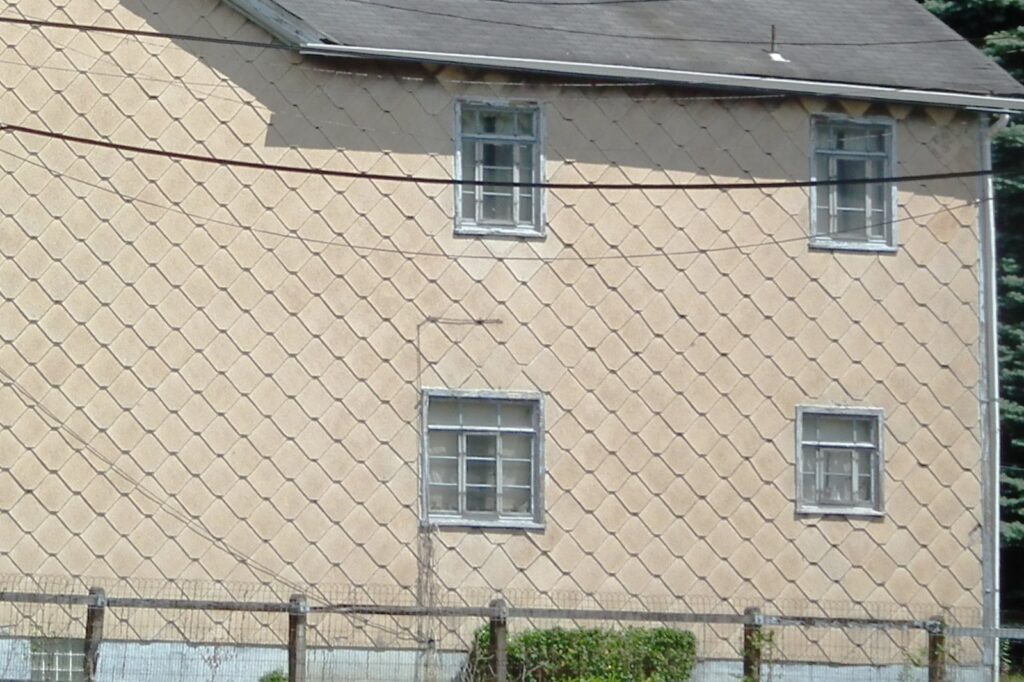
Asbestos cement siding is Portland cement reinforced with asbestos fibers. According to InterNACHI, the cement binds the fibers, so siding that is intact and left alone is a different situation from siding that is chipped, sawed, ground, sanded or deteriorating. InterNACHI also points out that this siding is brittle, chips and cracks easily, and can be cracked by a pressure washer.
Does the age of the house tell you anything?
Age is a clue, not an answer. The CPSC and InterNACHI both say that until the 1970s, many building products and insulation materials used in homes contained asbestos. InterNACHI adds that houses built between 1930 and 1950 may have asbestos as insulation.
EPA guidance published in 2009 says houses built before 1980 are more likely to contain asbestos, but that newer houses cannot be assumed to be free of it. No construction year guarantees that a home has none.
That matters in North Texas. U.S. Census Bureau estimates for 2025 show that about 42 percent of the housing units in Dallas County, about 30 percent in Tarrant County, and about 27 percent across the Dallas-Fort Worth metro area were built in 1979 or earlier. Those figures count all housing units, not only single-family houses, and they say nothing about what any one home contains. They do show how many local homes fall in the age group where the question is worth asking.
Is asbestos banned?
Not completely. The EPA's summary of federal actions shows a series of narrower rules rather than one total ban:
- 1973: the EPA banned spray-applied asbestos surfacing material used for fireproofing and insulating.
- 1975: the EPA banned the installation of certain crumbly (friable) asbestos pipe and block insulation.
- 1977: the CPSC issued a rule banning asbestos in consumer patching compounds and in artificial fireplace embers. It took effect in 1978.
- 1978: the EPA extended the spray-applied ban to remaining uses, including decorative ones.
- 1989 to 1991: the EPA issued a rule banning most asbestos-containing products. A federal appeals court overturned most of it in 1991. Only a handful of product bans survived, along with a ban on new uses.
- 2019: the EPA required its review before discontinued asbestos products could return to the market.
- 2024: the EPA finalized a rule banning the ongoing uses of chrysotile asbestos, which are industrial and automotive uses, with phase-out deadlines that run as late as 2037.
The 2024 rule does not address asbestos-containing materials already installed in buildings. The EPA has said it plans to propose a rule on those older, "legacy" materials by June 3, 2027. As of November 2026, no such rule is in place. These federal actions restrict making, importing and selling products. On their own, they do not require a homeowner to remove material that is already in a house.
What are the health risks?
The EPA identifies three major health effects of asbestos exposure: lung cancer, mesothelioma (a cancer of the lining of the chest and abdomen), and asbestosis, a serious, long-term, non-cancer disease of the lungs. The National Cancer Institute also links asbestos to cancers of the larynx and ovary.
- These diseases take a long time to appear. The National Cancer Institute says it can take 10 to 40 years or more after exposure. The CPSC and InterNACHI put it at about 20 to 30 years after first exposure.
- Smoking makes it worse. The National Cancer Institute and ATSDR report that smoking combined with asbestos exposure greatly raises the risk of lung cancer.
- Amount and duration matter. OSHA states that there is no safe level of asbestos exposure. At the same time, the CPSC notes that most people exposed to small amounts do not develop these health problems, and the National Cancer Institute notes that people who become ill were usually exposed on a regular basis, most often at work.
Exposure happens when fibers get into the air, which is what sanding, sawing, drilling, scraping, demolition and remodeling can do to these materials. The EPA's guidance for families is direct on this point: material that is not damaged or disturbed is not likely to pose a health risk, and the usual best course for material in good condition is to leave it alone. The Texas Department of State Health Services (DSHS) tells homeowners much the same thing: in most cases, asbestos in a home does not call for action. Questions about your own health belong with your doctor.
You cannot tell by looking
Both the EPA and InterNACHI say the same thing: unless a material is labeled, you generally cannot tell whether it contains asbestos by sight. Confirmation takes a laboratory.
- Sampling is a job for a professional. The EPA does not recommend taking samples yourself. A trained and accredited asbestos professional should do it, because sampling done incorrectly can be more hazardous than leaving the material alone.
- Testing is not always needed. If a material is in good condition and will not be disturbed, the EPA says the home does not need to be tested. Consider a professional asbestos inspection if materials are damaged or before you remodel.
- Use an accredited laboratory. Building material samples are typically analyzed by polarized light microscopy. The EPA points consumers to accredited professionals and laboratories, and the National Institute of Standards and Technology runs the accreditation program for asbestos fiber analysis labs.
What a home inspection does and does not cover
This is where expectations most often miss. In Texas, home inspections follow the TREC Standards of Practice. Under 22 Texas Administrative Code Section 535.227, an inspection is a limited visual survey and basic performance evaluation of the home's systems and components. The same rule says the inspector is not required to determine the presence, absence or risk of asbestos, and that environmental testing and destructive testing are outside the required scope.
InterNACHI's own Home Inspection Standards of Practice take the same position. They state that an inspector is not required to determine "the existence of environmental hazards, including lead paint, asbestos or toxic drywall." They also say the inspector describes the type of insulation observed but is not required to disturb insulation, identify what it is made of, or determine the materials used to wrap pipes, ducts or boilers. In Texas, the TREC rule is the one that governs.
In plain terms:
- A home inspection does not test for asbestos, identify it, or rule it out.
- A report that does not mention asbestos is not a statement that the home has none.
- An inspector may note that a material is of a type commonly associated with asbestos and recommend evaluation by a qualified asbestos professional. That is an observation, not a finding that asbestos is present.
- InterNACHI describes an asbestos inspection (a visual examination plus sampling, lab analysis and a written evaluation) as its own service, separate from a home inspection.
Timing matters for buyers. The TREC inspection report form advises that any further evaluations take place before contractual deadlines, such as the option period, run out. For more on what is included, see what we inspect.
Texas rules that buyers and owners should know
Seller's disclosure
Texas Property Code Section 5.008 and the TREC Seller's Disclosure Notice ask sellers whether they are aware of asbestos components in the home. The answer reflects what the seller knows. A "no" on the form is not a test result. Federal law does not require a seller to disclose asbestos, according to the EPA.
Licensing
Texas regulates asbestos work through the Texas Asbestos Health Protection Act and the rules in 25 Texas Administrative Code Chapter 296, administered by DSHS. Those licensing rules are written for public and commercial buildings. They exclude a single private residence and an apartment building with four or fewer units. That describes where the licensing rules apply. It is not a recommendation to do the work yourself. DSHS still points homeowners toward qualified asbestos inspectors, laboratories and consultants when material needs to be identified or disturbed, and it keeps a public list of licensees.
Demolition and renovation notices
According to DSHS, work on one private residence is not subject to the federal asbestos demolition and renovation rule, and a notification is not required. The rule can apply when two or more homes close together are handled by one owner as one project, when a house is demolished as part of a larger project, or when a building has more than four units. Federal worker safety rules can still apply to contractors, and cities may have their own permit requirements, so check with your city before a demolition or major renovation.
Disposal
The Texas Commission on Environmental Quality regulates how landfills accept asbestos waste, and treats discarded asbestos-containing material as a special waste. Call the landfill first to confirm that it accepts the material and how it must be packaged.
What to do next
If you are buying an older home
- Read the seller's disclosure, and remember that it reports the seller's knowledge only.
- Ask what is known about past renovations and when flooring, ceilings, siding and insulation were installed.
- If you plan to remodel, or if suspect materials are damaged, arrange an asbestos survey with a qualified asbestos professional during your option period.
- Use separate firms for assessment and for any corrective work. The CPSC and InterNACHI both warn about the conflict of interest when one company does both.
If you own a home with suspect materials
- Leave material that is in good condition alone, and check it from time to time without touching it. Look for tears, abrasions and water damage.
- Do not saw, sand, scrape or drill it.
- Do not dust, sweep or vacuum debris that may contain asbestos.
- Do not sand or try to level asbestos flooring or its backing. When flooring needs replacing, install new flooring over it if possible.
- Treat damage larger than the size of your hand as more than a minor repair, and call a professional.
Before you remodel
Find out whether asbestos is present before work starts, not after a wall or floor has been opened up. If it is, the options the CPSC and InterNACHI describe are repair, which means sealing the material (encapsulation) or covering it (enclosure), or removal. Removal is usually the most expensive choice and carries the greatest risk of releasing fibers, so both sources treat it as the last option unless remodeling or regulations make it necessary.
Sources
- InterNACHI: Asbestos: Facts and Tips for Home Inspectors and Homeowners, Home Inspection Standards of Practice, Vermiculite, Asbestos Cement Siding Inspection
- EPA: Learn About Asbestos, Protect Your Family from Exposures to Asbestos, Asbestos-Contaminated Vermiculite Insulation, EPA Actions to Protect the Public from Exposure to Asbestos
- CPSC: Asbestos in the Home
- ATSDR: Asbestos ToxFAQs and Health Effects of Asbestos
- National Cancer Institute: Asbestos Exposure and Cancer Risk
- OSHA: Asbestos
- Texas Real Estate Commission: TREC Rules (Standards of Practice, 22 TAC 535.227) and Seller's Disclosure Notice
- Texas Department of State Health Services: Asbestos Laws and Regulations and Asbestos Program FAQs
- Texas Commission on Environmental Quality: Waste Disposal
- U.S. Census Bureau: American Community Survey 2025, Table DP04
This article is general information, not legal, medical or environmental advice. Agency pages and rules were checked in November 2026 and can change. A home inspection by Buffalo Property Inspections is performed under the TREC Standards of Practice and is not an asbestos survey. Questions about what your inspection covers? Call or text (817) 767-3740, or schedule online.